A project proposal is a document that explains a problem, the project you plan to run to address it, who it will help, how much it will cost and how you will measure success. The standard sections are: title page, project summary, background and rationale, objectives, target beneficiaries, activities, timeline, budget, monitoring and evaluation, sustainability, and signatories. Below is a complete project proposal sample for a community project, written as a fill-in-the-blanks template you can copy. It works for youth organizations, student councils, barangay groups and non-profits in the Philippines.
Replace everything in [square brackets] with your own details. The example notes in parentheses show what a finished answer might look like. Delete them before you submit.
Before you write: three quick questions
- Who will read it? A barangay council, school administrator, LGU office, sponsor or grant-giver. Each cares about different things, so adjust your emphasis.
- What problem are you solving? If you can't say it in one sentence, the proposal will be hard to write.
- What does success look like? Pick numbers you can actually count: people trained, kilos collected, trees planted.
Project proposal sample (copy and fill in)
1. Title page
Project title: [Short, clear name, e.g. "Project [Name]: [What it does] for [Who]"]
Proponent: [Organization name]
Address: [Street, barangay, city or municipality, province]
Contact person: [Full name], [Position]
Mobile / email: [Mobile number] / [Email address]
Project location: [Barangay, city or municipality]
Project duration: [Start date] to [End date]
Total project cost: PhP [amount]
Amount requested: PhP [amount] [or in-kind items]
Date submitted: [Date]
2. Project summary
[Organization name] proposes to conduct [project title], a [one-day / one-month / six-month] project that will [main activity] for [number] [beneficiaries] in [location]. The project addresses [problem in one sentence]. It will run from [start date] to [end date] with a total cost of PhP [amount], of which PhP [amount] is requested from [recipient of the proposal].
(Example: "[Youth organization name] proposes a one-day coastal cleanup and waste-segregation seminar for 100 youth volunteers in Barangay [Name], addressing plastic waste along the shoreline.")
3. Background and rationale
[Paragraph 1: Describe the problem. Who is affected, where, and how? Use facts you can back up, such as barangay data, school records, a survey you conducted, or official statistics. Cite your source.]
[Paragraph 2: Explain why it matters now. What happens if nothing is done?]
[Paragraph 3: Explain why your organization is the right group to do this. Mention relevant past projects, skills or partners, only if true.]
[Optional: Link the project to a bigger goal, such as a barangay development plan or one of the United Nations Sustainable Development Goals, e.g. "This project supports SDG [number]: [goal name]."]
4. Objectives
General objective: To [overall change you want, e.g. "reduce plastic waste along the coastline of Barangay [Name]"].
Specific objectives. By the end of the project, we aim to:
- [Action verb + measurable result + deadline, e.g. "Train [number] youth volunteers on proper waste segregation by [date]."]
- [e.g. "Collect at least [number] kilograms of waste from [length] of shoreline."]
- [e.g. "Set up [number] labeled segregation bins with the barangay by [date]."]
Tip: good objectives are specific, measurable, achievable, relevant and time-bound (SMART).
5. Target beneficiaries
- Direct beneficiaries: [Number] [who, e.g. "public high school students aged 13 to 17"]
- Indirect beneficiaries: [Who else benefits, e.g. "families and fisherfolk in Barangay [Name]"]
- Selection criteria: [How you choose participants, e.g. "nominated by the school guidance office"]
6. Project description and activities
[One paragraph describing what will happen, in order.]
- Pre-project: [e.g. coordination with barangay officials, securing permits, recruiting volunteers, buying supplies]
- Activity 1: [Name, description, who leads it, how many join]
- Activity 2: [Name, description, who leads it, how many join]
- Activity 3: [Name, description, who leads it, how many join]
- Post-project: [e.g. evaluation, documentation, report to partners, thank-you to sponsors]
7. Program of activities (for one-day events)
- [7:00 AM] Registration
- [7:30 AM] Opening program: prayer, national anthem, welcome remarks by [name, position]
- [8:00 AM] [Activity / talk by resource speaker [name]]
- [10:00 AM] [Main activity]
- [12:00 PM] Lunch
- [1:00 PM] [Workshop / discussion]
- [3:00 PM] Closing program, awarding of certificates, closing remarks
8. Timeline (for longer projects)
- [Month / week 1]: [Planning, coordination, permits]
- [Month / week 2]: [Promotion, registration, procurement]
- [Month / week 3]: [Implementation]
- [Month / week 4]: [Evaluation and reporting]
9. Project team and responsibilities
- Project chairperson: [Name], overall lead and main contact
- Secretary: [Name], documentation, attendance, minutes
- Treasurer / finance: [Name], budget, receipts, liquidation
- Logistics: [Name], venue, supplies, transport
- Program and marketing: [Name], program flow, publicity, social media
- Partners: [Barangay, school, LGU office, sponsor and their role]
10. Budget
List every cost. Lenders, sponsors and offices read this section closely.
- [Item, e.g. "Snacks and lunch"]: [quantity] x PhP [unit cost] = PhP [total]
- [Item, e.g. "Tarpaulin, 3 x 6 ft"]: [quantity] x PhP [unit cost] = PhP [total]
- [Item, e.g. "Gloves, sacks and bins"]: [quantity] x PhP [unit cost] = PhP [total]
- [Item, e.g. "Certificates and printing"]: [quantity] x PhP [unit cost] = PhP [total]
- [Item, e.g. "Transportation"]: [quantity] x PhP [unit cost] = PhP [total]
- [Item, e.g. "Token for resource speaker"]: [quantity] x PhP [unit cost] = PhP [total]
- [Contingency, about 5 to 10% of the total]: PhP [total]
- Total project cost: PhP [amount]
11. Sources of funds
- [Organization funds]: PhP [amount]
- [Sponsors, e.g. "[Company name], in-kind snacks worth PhP [amount]"]: PhP [amount]
- [Amount requested from the recipient of this proposal]: PhP [amount]
- Total: PhP [amount]
12. Monitoring and evaluation
- Indicators: [What you will count, e.g. number of attendees, kilos of waste collected, pre- and post-test scores]
- Tools: [Attendance sheets, evaluation forms, photos, pre/post tests, weigh-in logs]
- Reporting: [e.g. "A post-activity report with photos, attendance and liquidation will be submitted to [recipient] within [number] days after the project."]
13. Sustainability
[How will the benefits continue after the project ends? e.g. "Trained volunteers will form a youth environment group that meets monthly," or "The barangay has agreed to maintain the bins."]
14. Risks and how we will manage them
- [Risk, e.g. "Bad weather"]: [Response, e.g. "Monitor PAGASA advisories; set a rain date of [date]."]
- [Risk, e.g. "Low turnout"]: [Response, e.g. "Pre-register participants and confirm two days before."]
- [Risk, e.g. "Injury"]: [Response, e.g. "First-aid kit and trained first-aider on site; coordinate with the barangay health station."]
15. Signatories
Prepared by:
[Signature over printed name]
[Position], [Organization]
Noted by:
[Signature over printed name]
[President / Adviser], [Organization]
Approved by:
[Signature over printed name]
[Position of approving official], [Office]
Attachments: [Organization profile], [Letters of support or commitment from partners], [Map or photos of project site], [Sponsorship package]
Tips to make your project proposal stand out
- Lead with the problem, not your organization. Readers fund results, not logos.
- Use real numbers. "100 students in Barangay [Name]" is stronger than "many youth."
- Keep the budget honest. Inflated costs damage trust. Get quotes from at least two suppliers if you can.
- Coordinate early. Talk to the barangay, school or LGU office before you submit. A proposal they already expect is easier to approve.
- Connect to bigger goals. Linking your project to a local plan or the UN Sustainable Development Goals shows the reader you see the bigger picture.
- Proofread and format. Use headings, page numbers and your letterhead. Ask someone outside your group to read it once.
- Report back. A clear post-activity report with photos and liquidation makes your next proposal much easier to approve.
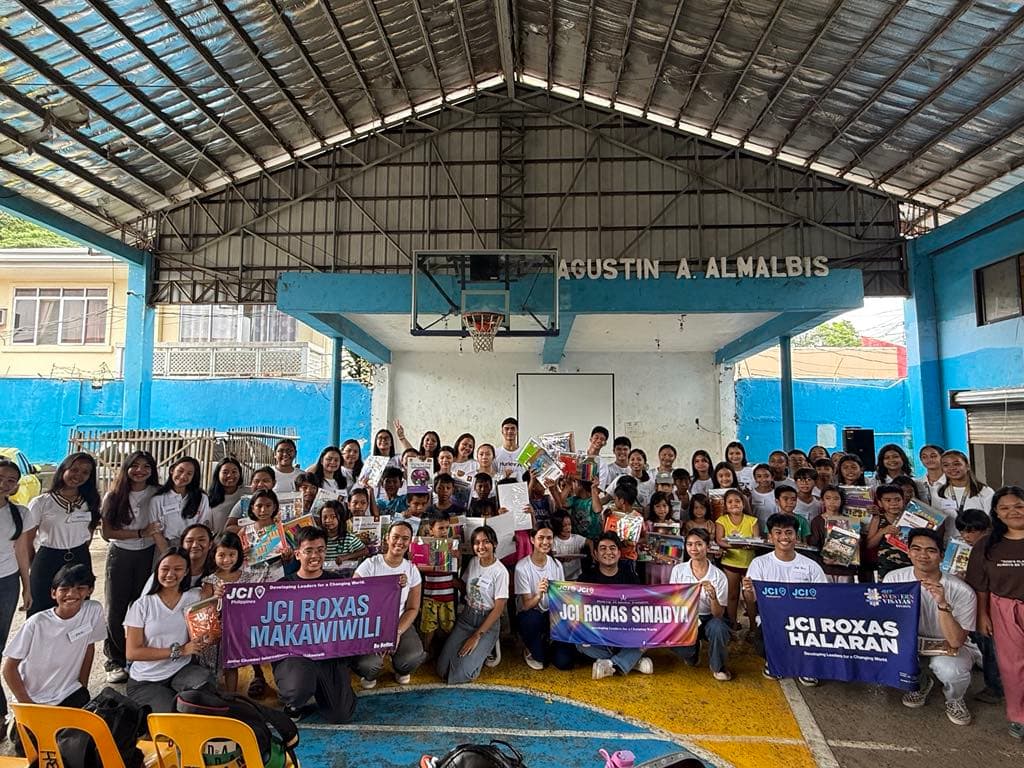
Two JCI Roxas Halaran projects show what specific numbers and funding lines look like in practice:
- Specific outputs: for Choco Hero on May 9, 2023, the chapter turned over 74 boxes of powdered choco malt milk drinks, each with 192 sachets, to daycare centers and barangay halls in six Roxas City barangays: Olotayan, Banica, Milibili, Dumolog, Baybay and Culasi.
- Clear funding asks: for Bags of Hope 2026, the chapter asked donors for PHP 250 per child and gave every student at Balaring Elementary School in Ivisan a school bag with learning materials, plus textbooks and two electric fans for the faculty.
Asking businesses for support too? Pair this proposal with our sponsorship letter sample. Planning an event specifically? See our event proposal template. New to community work? Start with community development: how to start.
Frequently asked questions
What are the parts of a project proposal?
Most include a title page, summary, background and rationale, objectives, target beneficiaries, activities, timeline, budget, sources of funds, monitoring and evaluation, sustainability, and signatories.
How long should a project proposal be?
For a small community project, three to eight pages is common. Follow any page limit or format the receiving office gives you.
What is the difference between a project proposal and an event proposal?
A project proposal covers a full initiative that may run over weeks or months. An event proposal focuses on a single event, such as a seminar, fun run or fair, and its program and logistics.
What is a rationale in a project proposal?
It is the "why" section. It explains the problem, who is affected, why it matters now, and why your group is the right one to act.
Turn your proposal into action
Writing a good proposal is a leadership skill, and so is carrying it out. At JCI Roxas Halaran, young men aged 18 to 40 plan and run community projects in Capiz. See what we've worked on in our projects, grab more free templates, or join us and lead a project of your own.